
Complex Domain Coloring using fztopng
Intro  |
| Gallery |
fztopng  |
| S-Lang |
| slsh |
| Complex Domain Coloring |
| SLxfig |
| Antennas |
| Thermochron |
| jedsoft.org |
fztopng is a S-Lang script that converts a function of a complex number over a region of the complex plane into a PNG image. The script requires at least version 2.1.0 of the S-Lang library, as well as PNG support.
The script may be downloaded from this link.
Running the script without any arguments will produce a usage message:
Version 0.1.0 Usage: ./fztopng [options] -f func | func.sl
Options:
 -x|--real xlo:xhi:#N        Grid for x=Real(z) (default: -2:2:#512)
 -y|--imag ylo:yhi:#N        Grid for y=Imag(z) (default: -2:2:#512)
 --iter N                    Iterate N type (default=1)
 --hsv                       Use HSV method (default)
 --hue=float,float           Min/Max values of Hue ([0->360])
 --sat=float,float           Min/Max values of Saturation ([0->1])
 --val=float,float           Min/Max values of Value ([0->1])
 --grad                      Use gradient method
 --rgb=int,int               Min/Max RGB values for gradient method
 -o file.png                 Output file (default: func.png)
 -h|--help                   This message

Note: The file func.sl must contain a function called f_of_z.
If the -f expr form is used, it must involve z, e.g., -f sin(z)
As the usage message shows, the script implements two methods for associating a color with a complex number: the HSV method and the Gradient method. The HSV method maps the phase and modulus of the complex number into the color's HSV representation using:
![H &=& \arg(z) \\
r &=& \log(1+|z|) \\
S &=& [1 + \sin(2\pi r)]/2 \\
V &=& [1 + \cos(2\pi r)]/2](autopng/fztopng.tm_eq1.png)
The above equations indicate that S and V lie in the range 0
to 1, whereas H is an angle that runs between 0 and 360 degrees. The
--hue, --sat, and --val options may be used to further
restrict the corresponding quantities to specified ranges. For
example,
fztopng --hue=240,270 myfunc.slwould produce a "blueish" image with the hue lying between 240 and 270 degrees.
In contrast the Gradient method uses the phase of the complex number
to linearly interpolate between two colors in the RGB
representation. It does not use the modulus at all. The two RGB
values may be specified using the --rgb option as integers
expressed in the hexadecimal form 0xRRGGBB, e.g.,
fztopng --grad --rgb=0xFF0000,0x00FFFF myfunc.slIn this example, as the hue increases from 0 to 360 degrees, the red component decreases from 255 (0xFF) to 0, while at the same time the green and blue components increase from 0 to 255 (0xFF).
The --iter option specifies the number of times the function is
to be iterated upon itself.
Unless specified by the -o option, the output PNG file will
have the same name as the input function file except the .png
filename extension will be used. For example,
fztopng myfunc.slwill produce a PNG file called
myfunc.png.
There are two ways of specifying the function: via a file containing a
S-Lang function called f_of_z, or via an expression on the
command-line using the -f option. An example of the latter
form is:
fztopng -x -8:8:#512 -y -2:2:#128 -o sin_hsv.png -f "sin(z)"This produces a PNG file called
sin_hsv.png containing the 512
by 128 pixel image:
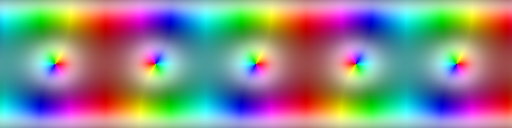
The most flexibility is achieved using a file coded in S-Lang
containing the function called f_of_z. See the
gallery for some examples of this approach.
Also the file could define a function f_of_z that reads a
pre-computed complex array from the disk and returns it. This could
be especially useful when dealing with very CPU intensive functions.


